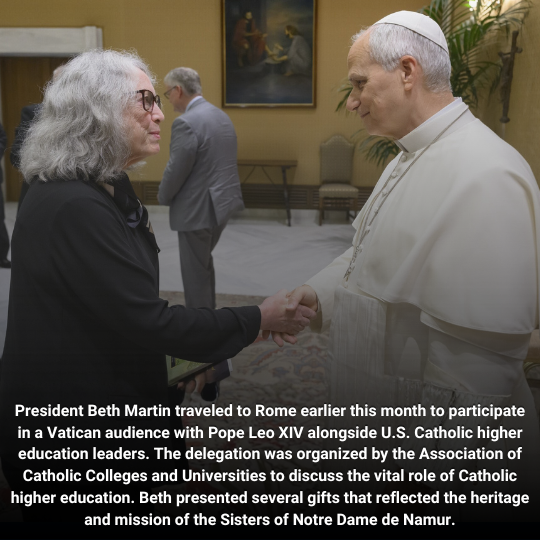
We recently had the opportunity to sit down with President Beth Martin as she prepares to retire at the end of this month, concluding an exceptional career at Notre Dame de Namur University (NDNU) and more than three decades in higher education.
Beth first joined NDNU in 1996 as a faculty member and went on to serve as the founding Dean of the School of Sciences, helping to shape academic programs and foster a culture of innovation.
Before returning to NDNU as its 19th President in 2021, she held senior leadership roles at Holy Names University, where she served as Vice President for Academic Affairs and Provost, and at Gonzaga University as Interim Provost and Senior Vice President.
As President, Beth has guided NDNU through one of the most pivotal chapters in its 175-year history. Under her leadership, the university undertook a bold institutional transformation – repositioning itself as a graduate and degree-completion-focused university dedicated to serving working adults and diverse learners.
Throughout her distinguished career, Beth has been a champion of student success, academic innovation, and institutional collaboration. Her leadership has strengthened educational outcomes and expanded opportunities for generations of students.
We invite you to enjoy this thoughtful “look back” at the legacy of a remarkable leader, trailblazer, mentor, and friend.
Please describe your journey from NDNU professor to President:
My relationship with Notre Dame de Namur University spans nearly three decades and has been one of the greatest privileges of my professional life. When I first joined NDNU in 1996 as a faculty member and program director in Counseling Psychology, I found a community deeply committed to educating the whole person and advancing the mission of the Sisters of Notre Dame de Namur.
Over time, I was given opportunities to serve in new ways, including setting up a Substance Abuse Center to train our students in a house donated by the city of Belmont. In 2001, the Provost at the time asked that I apply for the position of founding Dean of the School of Sciences. I had not considered administration prior to this, but when I was appointed, I discovered that I enjoyed the work and realized that I could touch the lives of more students as Dean than I would be able to reach as a faculty member. The experience of bringing together faculty from all the sciences – social, political, natural, and behavioral – was energizing. Together we created a mission for the new School of Sciences and grew together.
Returning to NDNU in 2021 felt like coming home. The university had shaped much of my professional life, and I was honored to help lead it during a pivotal moment in its history. Looking back, I never could have imagined as a young professor that I would one day have the privilege of serving as president, but I am profoundly grateful for the opportunity.
Looking back on your years of service to NDNU, what are some career standouts? Challenges? Successes?
The greatest challenge was also the greatest opportunity: ensuring the long-term sustainability of the university while remaining faithful to its mission. Like many small private institutions, NDNU faced significant financial and demographic pressures. The question was not simply how to survive, but how to create a future in which the university could continue serving students for generations to come. Prior to my arrival, the Board of Trustees and the Sisters had decided to sell the campus land and to close the undergraduate residential programs, choosing to concentrate on graduate studies and degree completion programs. This was a bold and momentous decision, but it also created a great deal of angst among the community. When all was said and done, however, it became quite clear that this decision was an amazing act of stewardship.
What stands out most is the courage and resilience of the NDNU community. Faculty, staff, trustees, alumni, donors, and the Sisters all worked together to navigate difficult decisions and embrace change. Through that collective effort, we were able to complete a transformative land transaction, eliminate debt, establish a substantial endowment, and position the university for a sustainable future.
Most important are the students whose lives have been changed through an NDNU education. Watching graduates walk across the commencement stage, most of them working adults or first-generation students, parents, and individuals overcoming significant obstacles – has always reminded me why this work matters.
Perhaps the success of which I am most proud is that we never lost sight of who we are. Throughout periods of change, NDNU has remained committed to human dignity, inclusion, social justice, and educational opportunity. Those values have guided us for 175 years and continue to guide us today.
What are you going to miss most about being here at the university?
Without question, the people.
I will miss the interactions with students, faculty, staff, alumni, trustees, donors, and the Sisters of Notre Dame de Namur. Universities are change agents. Every day, you encounter people who are learning, growing, solving problems, and imagining a better future.
I will miss being part of a mission-driven community that seeks to make a difference in the world. NDNU has never measured success solely by what its graduates achieve, but by how they use their education in service to others. Being part of that mission has been an honor.
What do you hope your legacy will be?
I don’t see my legacy defined by any single transaction or milestone, but rather by being part of an extraordinary team and a shared commitment to secure NDNU’s future. Together, we have helped create the conditions for the university’s mission to not only endure, but to flourish for the next 175 years.
What plans do you have for retirement?
I look forward to spending more time with family and friends, traveling, reading, and getting serious about gardening. I would also like to volunteer in the local adult literacy program.
What parting words do you have for our alumni?
My message is one of gratitude and confidence. Alumni are the living legacy of NDNU. You carry the university's mission into your professions, communities, and families every day. Thank you for the countless ways you support and represent this institution. As NDNU enters its next chapter, I hope you will remain engaged, stay connected, and continue sharing your gifts with the university and the world.
For the community?
Thank you for believing in NDNU and supporting its mission. For 175 years, this university has been a force for educational opportunity, social justice, and human dignity. While the university will continue to evolve, those values remain unchanged. The future of NDNU is bright because it is grounded in a mission that is as relevant today as it was in 1851.
For your successor?
Lead with courage, humility, and optimism. You will inherit a community that cares deeply about NDNU and its future. I have every confidence that the university's best days are still ahead.